Beyond Made-in-Nigeria Fashion: Why We Must Also Embrace Nigerian Digital Innovation
From Reno Omokri's #GrowNairaBuyNaija campaign to homegrown technology, discover why supporting Nigerian creativity must extend from the clothes we wear to the digital solutions we use.
· 11 min read
Over time, I have observed a recurring message in Reno Omokri's advocacy for Made-in-Nigeria products. Through his social media posts, he consistently encourages Nigerians to embrace, appreciate, and patronise products made within our own country.
His #GrowNairaBuyNaija campaign provides an important starting point for a broader conversation about local production, economic development, national identity, and our willingness to support homegrown innovation.
One particularly interesting aspect of his advocacy is his commitment to demonstrating the message through his own choices. Rather than simply asking Nigerians to wear locally made clothing, he regularly showcases Nigerian-made outfits, including Agbada and Ankara, to demonstrate that locally produced fashion can be a source of pride.
In a reported 2025 post, he presented ten Agbadas made with Aso Oke from Iseyin and invited his audience to choose their favourites. He has also publicly discussed designing his own Agbada using Nigerian-made materials. These examples illustrate how personal choices can become a platform for promoting local craftsmanship and creativity.
His advocacy also draws attention to the economic implications of Nigeria's dependence on imported clothing. In April 2025, BusinessDay reported that industry stakeholders estimated Nigeria spent approximately $4 billion annually on clothing imports, excluding additional informal imports. The figures were presented as part of a wider discussion about revitalising Nigeria's cotton, textile, and garment industries. https://businessday.ng/news/article/nigeria-spends-4bn-annually-on-clothing-imports-experts/
The underlying message is worth considering: the products we choose to buy can influence the businesses we support, the opportunities available to local producers, and the industries that have a chance to grow.
But this conversation should not end with fashion.
If we believe Nigerian-made clothing deserves recognition and patronage, shouldn't we also give Nigerian-built technology, digital products, and intellectual innovations a fair opportunity?
At Crestmas Hub, this is a question we believe deserves serious attention.
1. From the Clothes We Wear to the Technology We Use
When we talk about supporting Made-in-Nigeria products, our minds often turn to clothing, food, furniture, footwear, cosmetics, and other physical goods.
Yet, products are not limited to physical objects. A digital platform is also a product. Software is also an outcome of human creativity. An online service can represent months or years of research, planning, programming, testing, and continuous improvement.
Consider the difference between a Nigerian fashion designer who creates an original outfit and a Nigerian software developer who builds a platform to solve a problem.
One applies creativity and technical skill to produce clothing. The other applies creativity and technical skill to develop a digital solution.
Both are creating value. Both require expertise. Both need customers or users who are willing to explore what they have developed.
The products themselves are different, and the economic effects of purchasing them are not identical. Nevertheless, both demonstrate an important principle: Nigerian creativity deserves the opportunity to produce value and compete on its merits.
We cannot consistently encourage local manufacturers to grow while overlooking the work of Nigerian software developers, educational technology entrepreneurs, designers, and other digital innovators.
Supporting local innovation should be a broad commitment to recognising and fairly evaluating what Nigerians can create.
2. Why Supporting Local Innovation Matters to the Economy
Reno Omokri's advocacy draws attention to a fundamental economic idea: the choices consumers make can influence the growth of industries.
When people purchase locally manufactured clothing, they may support tailors, textile producers, designers, fabric merchants, and other participants in the production chain. The scale of the benefit depends on how much of the product's value is created locally.
A similar principle applies to digital businesses, although the value chain is different.
When a Nigerian-built digital platform attracts paying customers, subscription revenue can help the business maintain its service, improve its features, invest in infrastructure, and compensate the people involved in its development.
A successful digital business can also create opportunities for software developers, designers, technical support personnel, content creators, and other professionals.
However, these benefits are not automatic. They depend on the platform's ability to deliver value, attract users, operate sustainably, and compete effectively.
This is why patronage matters, but so do quality, trust, responsible development, and customer satisfaction.
A locally developed product must be useful enough to earn adoption and good enough to retain it.
The objective is not simply to buy Nigerian. It is to create an environment in which Nigerian products can grow because people find them useful, dependable, and worth supporting.
3. Local Innovation Should Not Be Confused with Mediocrity
Supporting Nigerian innovation does not mean that we should reject foreign products or accept substandard services because they were developed locally.
That would defeat the purpose of innovation.
Consumers deserve quality, reliability, security, accessibility, and value for money. A digital platform should protect users' information, function as intended, and provide a reasonable experience. Its developers should listen to feedback and continuously work to improve it.
At the same time, consumers should avoid assuming that an imported product is automatically superior to a Nigerian alternative.
The more constructive approach is to evaluate products fairly.
Does the product solve the problem? Is it reliable? Does it meet the user's needs? Is the price reasonable? Is support available? Does the provider demonstrate a commitment to improvement?
These are the kinds of questions that should guide our decisions.
If a Nigerian-built platform meets our needs, we should be willing to consider it seriously. If it falls short, we should communicate our concerns constructively and allow its developers the opportunity to respond.
We should support Nigerian innovation without lowering our standards, and maintain high standards without dismissing Nigerian innovation.
This balance is essential to building a competitive technology ecosystem.
4. The Role of Nigerian Digital Innovation in Education and Research
One area where locally developed digital solutions can make a practical difference is education.
Lecturers, teachers, researchers, schools, training providers, and businesses regularly need to create forms, collect information, conduct surveys, administer quizzes, and assess performance.
These activities are important, but managing them manually can require considerable time and effort.
Digital platforms can help users organise these activities, distribute forms, collect responses, administer assessments, and manage information more efficiently.
For example, a university researcher conducting a questionnaire survey may need a convenient way to distribute questions and collect participants' responses. A lecturer may need to prepare an online quiz for students. A school may require tools for administering assessments, while a business may need an online form to register participants or collect feedback.
The availability of appropriate digital tools can help users manage such tasks more conveniently.
This is where Nigerian educational technology developers have an opportunity to contribute. By understanding the needs of local educators, researchers, institutions, and businesses, they can develop solutions that respond to practical challenges.
Such solutions must still meet appropriate standards for functionality, usability, privacy, security, and reliability. But their Nigerian origin should not be a reason to overlook them.
We should be asking two questions: What problems are our innovators solving, and how can we help useful solutions reach the people who need them?
5. Crestmas Form: Supporting a Nigerian-Built Digital Platform
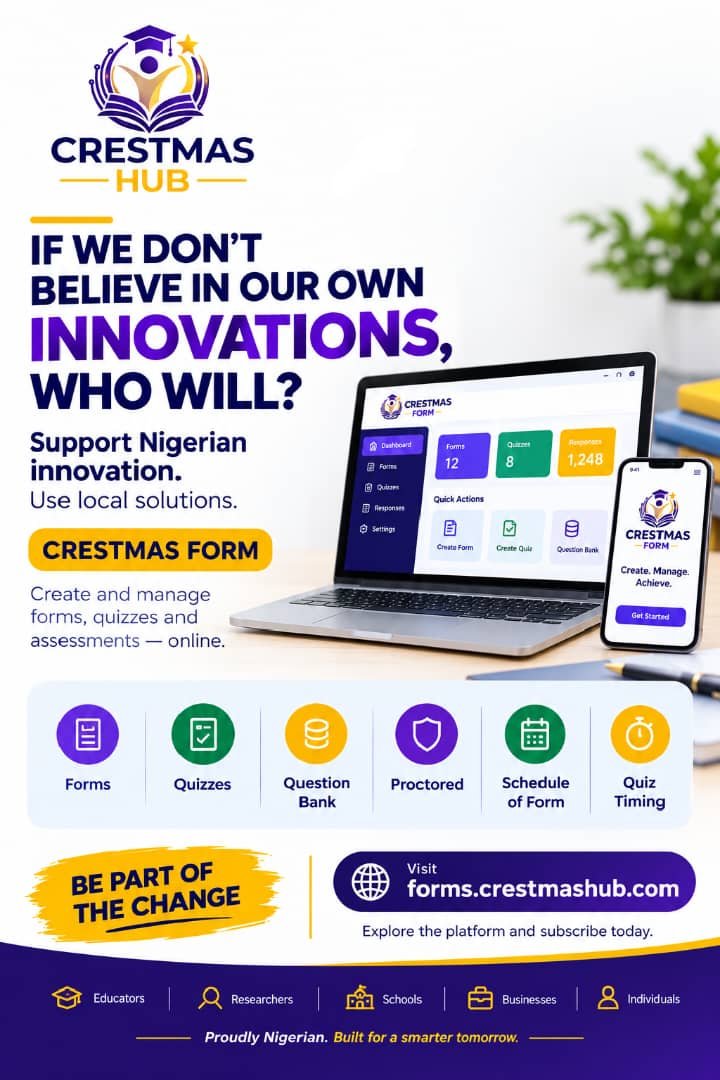
This belief in local creativity and practical innovation is part of the thinking behind Crestmas Form, a digital platform developed under Crestmas Hub.
Crestmas Form enables users to create and manage online forms, quizzes, and assessments.
The platform is intended for people and organisations that need practical digital tools for information collection, research, teaching, learning, and assessment.
Consider some of the people who may benefit:
- Lecturers and teachers who need to create quizzes and assessments for their learners.
- Researchers and students who need to develop questionnaires and collect survey responses.
- Schools and educational institutions seeking digital tools to support assessment activities.
- Training providers who need to administer quizzes and evaluate participants.
- Businesses and organisations that need online forms for registrations, feedback, and information collection.
These are practical activities that take place every day. Digital tools can help users organise them more effectively.
Crestmas Form represents our contribution to this space. We are working to provide a useful platform that serves real needs and offers users a convenient way to manage forms, quizzes, and assessments online.
We also recognise that building a digital product is an ongoing process. It requires listening to users, improving the service, maintaining reliability, and responding to changing needs.
For this reason, we welcome people who are willing to explore the platform, provide constructive feedback, recommend it to others, and subscribe when it meets their needs.
Our goal is not to ask people to use Crestmas Form simply because it is Nigerian-built. We want them to explore what it offers and make an informed decision about its usefulness.
We believe that Nigerian-built digital solutions deserve the opportunity to demonstrate their value through practical use.
6. Why Your Subscription Matters
One of the most practical ways to support a subscription-based digital product is to become a paying user when the product meets your needs.
A subscription is more than an expression of encouragement. It is a commercial decision based on the value a service provides.
For a digital business, sustainable subscription revenue can help cover hosting, maintenance, development, customer support, and other operating expenses. It can also provide resources for future improvements.
Of course, a subscription does not guarantee that every platform will succeed. Long-term success depends on whether the product continues to deliver value and whether the business manages its resources responsibly.
Nevertheless, users play an important role in determining whether useful products can build a sustainable customer base.
If you are a lecturer who regularly creates assessments, a researcher who needs online questionnaires, or a business owner who collects information, consider whether Crestmas Form can support your work.
If it meets your requirements, subscribing is a practical way to use the platform while contributing to the sustainability of the service.
You can also support local digital innovation by sharing useful platforms with colleagues, recommending them to relevant institutions, and offering honest feedback.
These actions help connect creators with potential users.
7. What Can We Learn from the Made-in-Nigeria Movement?
The broader lesson from campaigns such as #GrowNairaBuyNaija is that supporting local production requires more than praising it in public.
It requires deliberate choices.
If we admire Nigerian fashion, we can explore the work of local designers and purchase their products when they meet our needs. If we value Nigerian agriculture, we can consider locally produced food. If we believe in Nigerian technology, we can discover and evaluate the digital solutions being developed around us.
This does not mean every product must be local or that imported goods have no place in our economy. International trade, knowledge exchange, and access to global technology remain important.
Rather, it means that our purchasing and adoption decisions should not be shaped by the assumption that foreign origin automatically equals better quality.
We should give Nigerian innovators a fair opportunity to compete.
We should also expect them to earn our trust through the quality of their work.
For individuals, this may mean trying a Nigerian-built application. For a university, it may mean considering a suitable local platform during its technology evaluation process. For a business, it may mean comparing a Nigerian-developed service with alternatives before making a decision.
For developers, it means continuing to build products that solve meaningful problems.
Each group has a role to play in strengthening the innovation ecosystem.
Conclusion: Let Us Support What Nigerian Minds Create
Reno Omokri's advocacy for Made-in-Nigeria clothing, including his public showcases of Agbada, Ankara, and Aso Oke, offers a useful starting point for thinking about local production and national development.
His message invites us to consider how our everyday choices can influence the businesses and industries we support.
That conversation should extend to the digital economy.
Nigerians are capable of developing ideas, building businesses, creating software, and designing solutions that address real-world problems. Those innovations deserve to be discovered, evaluated fairly, and supported when they provide genuine value.
At Crestmas Hub, we believe in contributing to this process through the development of practical digital solutions.
Crestmas Form is our contribution to Nigerian digital innovation.
If you are a lecturer, teacher, researcher, student, school administrator, training provider, or business owner who needs to create and manage online forms, quizzes, or assessments, we invite you to explore the platform.
Visit https://forms.crestmashub.com/ to get started. Explore its features and subscribe if it meets your needs.
And when you discover a useful Nigerian-built solution, consider sharing it with others who could benefit from it.
Let us recognise the creativity of our people, support innovation through meaningful use, and continue to demand quality from the products we choose.
Don't just celebrate Nigerian innovation. Discover it. Use it. Recommend it. And when it delivers value, support its growth.
Support local innovation. Celebrate Nigerian creativity. Build for the world.
No comments yet. Start the conversation.